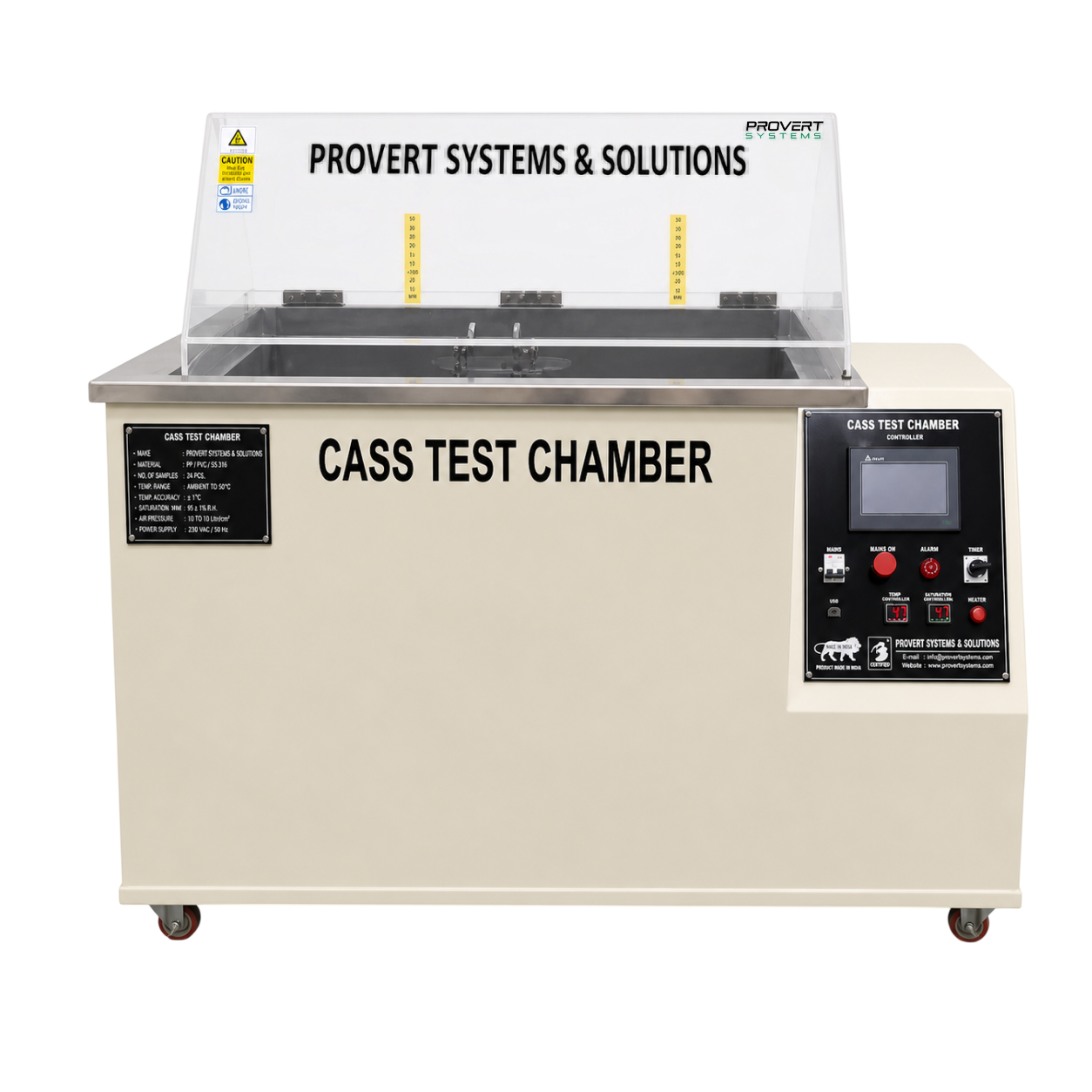
The CASS Test Chamber is engineered to simulate highly corrosive environments using copper-accelerated salt spray (fog) conditions. This accelerated testing method enables manufacturers to evaluate corrosion resistance of coated and plated components in a significantly reduced timeframe.
With advanced control over temperature, humidity, and fog generation, the chamber ensures consistent exposure conditions for accurate and repeatable testing. It is widely used in industries where corrosion resistance is critical for product performance and long-term reliability.
Key Features
- Designed as per ASTM B368 and ISO 9227 standards
- Double-walled construction for thermal stability
- Uniform salt fog distribution for consistent testing
- Solid-state programmable temperature controller
- Corrosion-resistant PT-100 sensor for accuracy
- Integrated air regulator, pressure gauge, and timer
- High-precision fog collection system
- User-friendly touchscreen interface
- Suitable for continuous and long-duration testing
- Built with corrosion-resistant materials
Advanced Features
- PLC & HMI-based smart control system
- Real-time data logging with graphical visualization
- Remote monitoring via mobile and PC without additional software
- Programmable cyclic test profiles
- Alarm system with event history tracking
- Performance graph (Time vs Temperature & Humidity)
- User activity and logging reports
- Automated safety features for over-temperature and pressure
- Screenshot and report generation capability
Construction & Build
- Inner chamber made of SS316 (high corrosion resistance)
- Outer body options: FRP / SS304 / Mild Steel
- Double-walled insulated structure
- Non-corrosive saturator tank with auto water level control
- High-pressure resistant vessel for continuous operation
- Tape heater system for uniform heating (no direct radiation)
- Transparent lid for observation
- Heavy-duty industrial structure
Applications
- Automotive components and coatings
- Electroplated and painted surfaces
- Aerospace and defense materials
- Hardware and fasteners testing
- Marine and outdoor equipment
- Industrial coating validation
Customization Options
- Multiple chamber sizes (500L to 1800L and beyond)
- Choice of material construction (FRP / SS / Hybrid)
- PLC-based advanced automation options
- Custom test cycle programming
- Additional safety and monitoring integrations
- Industry-specific configurations
Why Choose CASS Test Chamber
- Accelerated corrosion testing for faster results
- High accuracy and repeatability in testing
- Compliance with global testing standards
- Advanced automation for efficient operation
- Designed for continuous industrial usage
- Reliable performance in critical environments
- Flexible configurations based on application needs
- Trusted solution for coating and material validation
 FAQS
FAQS
