Environmental test chambers and climatic chambers are widely used in laboratories, manufacturing facilities, and research centres to evaluate how products respond to controlled environmental conditions. Although the terms are often used interchangeably, their meanings can differ depending on the equipment manufacturer, testing application, and industry.
An environmental test chamber is a broad term for equipment designed to simulate environmental stresses such as temperature, humidity, thermal shock, corrosion, dust, or other conditions. A climatic chamber generally refers to a system designed to reproduce controlled climatic conditions, particularly temperature and humidity.
Understanding the distinction can help engineers and quality-control professionals select equipment that meets their testing requirements without unnecessary complexity or cost.
This guide explains the differences between environmental test chambers and climatic chambers, their working principles, applications, testing standards, and important selection factors.
Environmental Test Chamber vs Climatic Chamber: Quick Answer
The main difference is terminology and scope rather than a universally defined technical distinction.
An environmental test chamber is a broad category of equipment used to simulate specified environmental stresses. A climatic chamber typically focuses on temperature, humidity, and related climatic conditions.
However, a temperature and humidity environmental test chamber may perform exactly the same functions as equipment marketed as a climatic chamber.
Therefore, the two terms should not automatically be treated as different equipment types.
The most reliable way to compare chambers is to examine their technical specifications, operating capabilities, and supported testing procedures rather than relying on their names.
What is an Environmental Test Chamber?
An environmental test chamber is a controlled testing system used to evaluate product performance under specified environmental conditions.
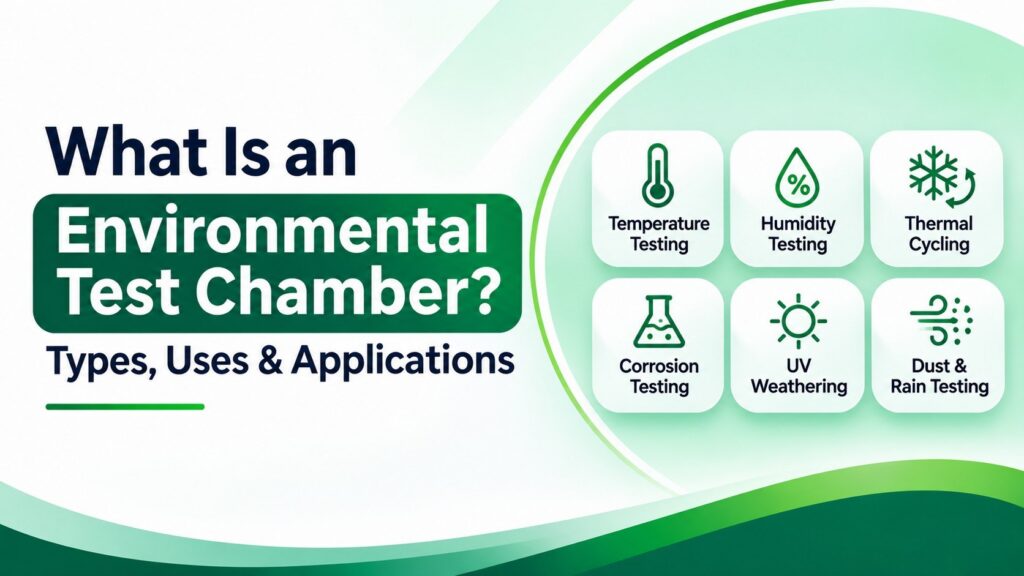
Depending on its design, it may reproduce high or low temperatures, humidity, rapid temperature changes, corrosion exposure, dust, water ingress, or reduced atmospheric pressure.
Environmental testing is commonly used in product development, reliability assessment, quality assurance, and laboratory evaluation.
Common Types of Environmental Test Chambers
Environmental testing equipment includes several specialized chamber categories.
Temperature and Humidity Chambers: Maintain controlled temperature and moisture conditions for climatic testing.
Thermal Shock Chambers: Expose specimens to rapid transitions between temperature extremes.
Salt Spray Chambers: Generate controlled saline mist environments for corrosion testing.
UV Weathering Chambers: Simulate specified ultraviolet exposure and weathering conditions.
Dust and Rain Test Chambers: Evaluate resistance to dust and water ingress.
Altitude Test Chambers: Simulate reduced atmospheric pressure for relevant applications.
Walk-In Environmental Chambers: Provide larger testing spaces for oversized specimens or assemblies, with environmental capabilities depending on the configuration.
Each chamber type is designed for particular testing requirements.
For a broader explanation of chamber categories and their applications, read our guide on what an environmental test chamber is.
What is a Climatic Chamber?
A climatic chamber is a controlled testing enclosure used to simulate defined climatic conditions, typically temperature and relative humidity.
These chambers are commonly used to evaluate how products and materials respond to heat, cold, moisture, and changes in environmental conditions.
Climatic chambers may support:
- Constant-temperature testing
- High- and low-temperature exposure
- Steady-state humidity testing
- Cyclic damp heat testing
- Programmed temperature cycling
- Combined temperature and humidity exposure
The exact functions depend on the chamber’s design and specifications.
For example, an electronics manufacturer may use a climatic chamber to evaluate a circuit board under elevated temperature and humidity conditions.
Similarly, a packaging laboratory may use controlled climatic conditions to assess moisture absorption or dimensional changes in materials.
Are Climatic Chambers and Temperature and Humidity Chambers the Same?
In many applications, yes.
The terms climatic chamber, climatic test chamber, and temperature and humidity test chamber are frequently used for equipment with similar operating capabilities.
However, the precise meaning may vary between manufacturers.
A chamber described as climatic may offer temperature control only, combined temperature and humidity control, or additional features depending on its configuration.
To understand the operating systems involved, see our guide to the working principle of temperature and humidity test chambers.
Environmental Test Chamber vs Climatic Chamber: Key Differences
The following table explains how these terms are commonly used.
| Comparison Factor | Environmental Test Chamber | Climatic Chamber |
|---|---|---|
| General meaning | Broad category of environmental testing equipment | Equipment for controlled climatic conditions |
| Main purpose | Evaluate specified environmental stresses | Evaluate temperature, humidity and climatic exposure |
| Temperature testing | Available in suitable chamber types | Common capability |
| Humidity testing | Available in suitable chamber types | Common capability, depending on model |
| Thermal shock testing | Available in dedicated thermal shock systems | Not a standard capability of every climatic chamber |
| Corrosion testing | Available in dedicated corrosion chambers | Generally requires separate equipment |
| Dust and rain testing | Available in specialized ingress-testing equipment | Generally requires separate equipment |
| Typical applications | Broad industrial and laboratory testing | Climatic reliability and material testing |
| Equipment selection | Based on the environmental stress and test method | Based on climatic conditions and test method |
Important: This comparison describes common industry terminology, not a strict classification established by a single universal standard.
A climatic chamber is often considered a type of environmental test chamber.
How Do Environmental Test Chambers Work?
The working principle of an environmental test chamber depends on the environmental conditions it is designed to simulate.
For temperature-controlled chambers, heating and cooling systems regulate the internal temperature.
For humidity-controlled systems, humidification and dehumidification equipment adjusts moisture levels.
Other specialized environmental chambers use different operating mechanisms.
Temperature Control
Heating and refrigeration systems regulate the chamber temperature according to a programmed setpoint or test profile.
Temperature sensors provide measurements to a controller, which adjusts the system to maintain the required conditions.
Humidity Control
Humidity-controlled chambers use moisture-generation and removal systems to maintain specified relative humidity conditions.
Humidity sensors continuously monitor the test environment.
Air Circulation
Air circulation systems distribute conditioned air throughout the chamber.
Proper circulation helps maintain consistent environmental conditions across the usable test space.
Monitoring and Data Logging
Depending on the equipment, monitoring systems may record temperature, humidity, exposure duration, alarms, and other parameters.
These records can support test traceability and quality documentation.
Specialized systems such as salt spray, UV weathering, and dust chambers use different methods appropriate to their testing objectives.
How Does a Climatic Chamber Work?
A climatic chamber typically uses a combination of heating, refrigeration, air circulation, sensors, and programmable control systems.
When humidity control is provided, the system also includes humidification and dehumidification components.
The chamber continuously measures internal conditions and adjusts the relevant systems to follow the programmed test profile.
Example of a Climatic Testing Cycle
A test procedure might require the following sequence:
- Stabilize the chamber at a defined starting temperature.
- Increase the temperature to the required setpoint.
- Maintain the specified temperature and humidity for a defined period.
- Change the environmental conditions according to the test profile.
- Record measurements and evaluate the specimen after exposure.
The actual cycle depends on the applicable testing standard or engineering specification.
The specimen may require additional time to reach the intended temperature even after the chamber air reaches its setpoint.
Applications of Environmental Test Chambers and Climatic Chambers
Both types of equipment support product development, reliability evaluation, and quality assurance.
The appropriate system depends on the environmental conditions that must be simulated.
1. Automotive Industry
Automotive components may encounter temperature extremes, humidity, dust, and water exposure.
Climatic chambers are commonly used for temperature and humidity evaluation of electronic control units, sensors, connectors, and other assemblies.
Other environmental test equipment may be required for corrosion, ingress protection, or rapid thermal shock testing.
2. Electronics and Electrical Industry
Electronic components can be affected by moisture, thermal expansion, and temperature changes.
Climatic chambers support controlled temperature and humidity testing of circuit boards, sensors, power electronics, and electrical assemblies.
Dedicated thermal shock systems may be used when rapid temperature transitions are required.
3. Aerospace and Defence Industry
Aerospace and defence equipment may experience extreme temperatures, humidity, reduced atmospheric pressure, and other demanding conditions.
Climatic chambers can support temperature and humidity exposure testing.
Specialized environmental systems may be required for altitude simulation or other qualification procedures.
4. Pharmaceutical Industry
Pharmaceutical stability testing uses controlled environmental conditions to evaluate the stability of medicines and related products.
Specialized stability chambers maintain defined temperature and humidity conditions according to applicable stability protocols.
These systems may require additional qualification, calibration, monitoring, documentation, and regulatory controls.
5. Industrial Manufacturing
Industrial manufacturers use environmental testing equipment to evaluate materials, coatings, electrical assemblies, and finished products.
Climatic chambers are useful when temperature and humidity are the primary testing conditions.
Other environmental chambers are selected when corrosion, UV exposure, dust, water ingress, or other stresses must be investigated.
Environmental Testing Standards: Do They Differ?
Environmental test chambers and climatic chambers may be used for testing procedures defined by international standards.
The applicable standard depends on the test being performed rather than the equipment’s marketing name.
| Standard | Testing Application |
|---|---|
| IEC 60068-2-1 | Cold testing |
| IEC 60068-2-2 | Dry heat testing |
| IEC 60068-2-14 | Change of temperature |
| IEC 60068-2-30 | Cyclic damp heat |
| IEC 60068-2-78 | Steady-state damp heat |
| ASTM B117 | Salt spray testing |
| ISO 9227 | Salt spray corrosion testing |
| IEC 60529 | Degrees of protection against ingress |
| MIL-STD-810 | Environmental engineering and laboratory testing |
For example, a climatic chamber may be suitable for a specified damp heat procedure under IEC 60068-2-78 if its performance meets the relevant requirements.
A salt spray test, however, generally requires dedicated corrosion-testing equipment.
A chamber’s ability to achieve a temperature or humidity setpoint does not automatically demonstrate compliance with an entire testing standard.
The test procedure, specimen preparation, exposure duration, instrumentation, and acceptance criteria must also be considered.
Which is Better: Environmental Test Chamber or Climatic Chamber?
Neither term identifies equipment that is universally better.
The correct choice depends on the test objective.
Choose a Climatic Chamber When:
- The main requirement is temperature and humidity testing.
- The product requires controlled climatic exposure.
- The test procedure specifies steady-state or cyclic damp heat.
- The application involves temperature cycling within the chamber’s capabilities.
- The required operating conditions fall within the chamber’s specified performance range.
Choose Specialized Environmental Testing Equipment When:
- Rapid thermal shock testing is required.
- Corrosion resistance must be evaluated using salt spray.
- Dust or water ingress testing is required.
- UV weathering exposure is part of the test programme.
- Reduced atmospheric pressure must be simulated.
- The required environmental stress cannot be reproduced by a conventional climatic chamber.
The key is to match the equipment to the test method.
Important Specifications to Compare Before Buying
When comparing environmental and climatic chambers, review their technical capabilities rather than relying on product names.
Temperature Range
Confirm the minimum and maximum temperatures required for the test.
A wider temperature range is not always necessary if the testing programme operates within narrower limits.
Humidity Operating Range
If humidity control is required, check the supported relative humidity range at the intended temperatures.
Not every humidity setpoint is achievable across the entire temperature operating range.
Chamber Capacity
Ensure that the test specimen fits within the usable test space with adequate airflow clearance.
Consider specimen dimensions, weight, fixtures, and heat generation.
Temperature Uniformity and Stability
Temperature uniformity describes differences between measurement locations within the chamber.
Temperature stability describes temperature variation over time at a defined measurement point.
Both are important for repeatable testing.
Heating and Cooling Ramp Rate
For temperature cycling, verify that the chamber can achieve the required heating and cooling rates.
Actual performance may differ when the chamber contains a substantial test load.
Monitoring and Data Logging
Depending on the application, useful features may include programmable profiles, alarms, data logging, remote monitoring, and test-result export.
Calibration and Maintenance
Regular calibration and maintenance help maintain confidence in chamber performance.
Review calibration requirements, service availability, and long-term maintenance needs before selecting equipment.
For a more detailed evaluation, read our guide on how to choose the right environmental test chamber.
Common Misconceptions About Environmental and Climatic Chambers
Misconception 1: Environmental Chambers and Climatic Chambers Are Completely Different
Not necessarily.
The terms overlap considerably, and many climatic chambers are also environmental test chambers.
The distinction depends on how the equipment is described and what conditions it can simulate.
Misconception 2: Every Environmental Test Chamber Can Perform All Environmental Tests
This is incorrect.
A temperature and humidity chamber cannot automatically perform salt spray, UV weathering, thermal shock, or dust ingress testing.
Different test methods require suitable equipment designs.
Misconception 3: A Wider Temperature Range Always Means Better Equipment
A wider operating range does not automatically make a chamber more suitable.
Uniformity, stability, load capacity, ramp rate, monitoring features, and the required test procedure may be more important.
Misconception 4: Meeting a Chamber Setpoint Guarantees Standard Compliance
Reaching a specified temperature or humidity condition is only one part of many standardized testing procedures.
Complete compliance depends on following the relevant test method and acceptance requirements.
Conclusion
Environmental test chambers and climatic chambers are important tools for evaluating how products respond to controlled environmental conditions.
Although the terms are frequently used interchangeably, environmental test chamber is generally a broader category, while climatic chamber commonly refers to equipment designed for temperature and humidity testing.
The most important consideration is not the equipment name but whether its capabilities meet the required testing conditions and applicable standards.
By comparing operating ranges, chamber capacity, temperature uniformity, ramp rate, monitoring features, and maintenance requirements, engineers can select equipment that supports reliable environmental testing.
For application-specific testing requirements, consulting an experienced environmental testing equipment manufacturer, such as Provert Systems, can help clarify suitable chamber configurations.