Choosing the right environmental test chamber is an important decision for manufacturers, research laboratories, and quality-control teams. The equipment must reproduce the required environmental conditions accurately while accommodating the product being tested and supporting relevant industry standards.
Environmental test chambers are used to evaluate how products, materials, and components respond to temperature extremes, humidity, rapid thermal changes, corrosion, and other environmental stresses.
However, not every chamber is suitable for every testing application. Selecting equipment based only on price, temperature range, or chamber size can lead to inadequate testing capabilities, inconsistent results, and unnecessary operating costs.
This guide explains how to choose an environmental test chamber based on testing requirements, technical specifications, industry applications, and long-term operational needs.
How to Choose an Environmental Test Chamber: Quick Answer
To choose the right environmental test chamber, first identify the environmental conditions your product must withstand and the testing standards that apply.
Then evaluate the following factors:
- Type of environmental testing required
- Temperature and humidity operating ranges
- Internal chamber dimensions and specimen capacity
- Temperature stability and uniformity
- Heating and cooling ramp rates
- Applicable testing standards
- Controller, monitoring, and data-logging capabilities
- Calibration, maintenance, and technical support
- Installation requirements and total operating cost
The best environmental test chamber is not necessarily the one with the widest operating range. It is the one that can reliably achieve the specific conditions required by your testing programme.
1. Identify Your Environmental Testing Requirements
Before comparing environmental test chamber specifications, define the purpose of your testing programme.
Different products experience different environmental stresses during manufacturing, storage, transportation, and operation.
For example, an electronic component may require temperature cycling and humidity testing, while a coated metal component may require corrosion resistance testing.
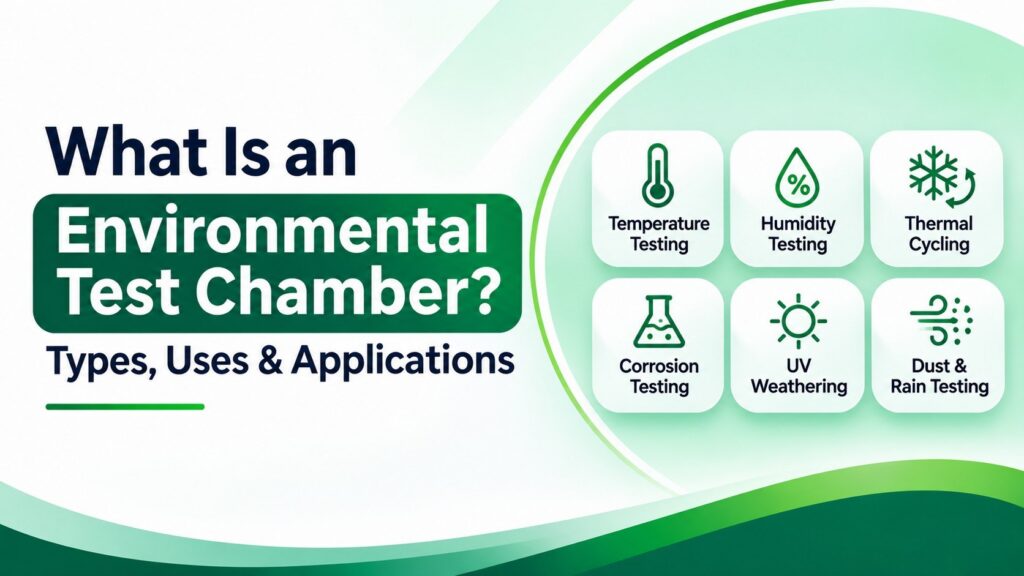
Common environmental testing requirements include:
- High-temperature testing: Evaluates performance under elevated temperatures.
- Low-temperature testing: Investigates product behaviour in cold environments.
- Humidity testing: Evaluates the effects of moisture exposure.
- Temperature cycling: Assesses the effects of repeated temperature changes.
- Thermal shock testing: Investigates product response to rapid temperature transitions.
- Salt spray testing: Evaluates corrosion resistance under defined saline exposure.
- Dust and rain testing: Assesses resistance to particulate matter and water ingress.
- UV weathering testing: Evaluates material degradation under controlled ultraviolet exposure.
These tests require different equipment configurations.
A conventional temperature and humidity chamber cannot automatically perform salt spray, UV weathering, or thermal shock tests.
Questions to Ask Before Selecting a Chamber
Start with these questions:
- What product or material will be tested?
- Which environmental conditions must be simulated?
- Is the test intended for development, reliability evaluation, or compliance?
- Which testing standard or customer specification applies?
- What are the required exposure durations and test cycles?
- Will the equipment be used for one product or multiple applications?
Clearly defined requirements help prevent the purchase of equipment that is unsuitable or unnecessarily complex.
2. Choose the Appropriate Type of Environmental Test Chamber
Environmental test chambers are available in different configurations based on the conditions they simulate.
| Chamber Type | Main Testing Purpose | Suitable Applications |
|---|---|---|
| Temperature and Humidity Chamber | Controlled temperature and moisture exposure | Electronics, automotive, industrial components |
| Thermal Shock Chamber | Rapid transitions between temperature extremes | Electronic assemblies, semiconductors |
| Salt Spray Chamber | Corrosion resistance testing | Metals, coatings, fasteners |
| UV Weathering Chamber | Accelerated UV and weathering exposure | Plastics, paints, outdoor materials |
| Dust Test Chamber | Dust ingress evaluation | Electrical enclosures, industrial equipment |
| Rain Test Chamber | Water ingress evaluation | Outdoor electronics, automotive components |
| Walk-In Environmental Chamber | Large-scale climatic testing | Large assemblies, industrial equipment |
| Altitude Test Chamber | Reduced atmospheric pressure testing | Aerospace equipment |
The appropriate equipment depends on the required test procedure.
For example, a manufacturer investigating corrosion resistance should select equipment designed for the relevant corrosion test rather than a standard climatic chamber.
Similarly, a product requiring rapid temperature transitions may need a dedicated thermal shock system.
3. Evaluate Temperature Range and Operating Performance
Temperature range is one of the most important environmental chamber specifications.
Different products require different testing temperatures depending on their operating environments and qualification requirements.
Some chambers are designed for moderate climatic testing, while specialized equipment supports more extreme temperature conditions.
Minimum and Maximum Temperature
Confirm that the chamber can achieve the required minimum and maximum temperatures.
The required range should come from the test standard, customer specification, or engineering test plan.
Avoid selecting equipment solely because it offers a wider temperature range than competing models.
A wider range may increase cost without providing additional value for the intended application.
Temperature Stability
Temperature stability refers to temperature variation over time at a specified measurement location under defined operating conditions.
Stable temperature control is important when a test requires prolonged exposure at a particular setpoint.
Temperature Uniformity
Temperature uniformity describes the temperature differences between measurement locations within the chamber’s usable test space.
Uniformity is especially important when testing multiple specimens or larger assemblies.
A chamber may maintain its controller setpoint while still exhibiting temperature differences across the test space.
Therefore, temperature stability and uniformity should be evaluated separately.
Performance Under Load
Chamber performance may change when specimens are placed inside.
Large, dense, or heat-generating specimens can affect cooling performance, airflow, and temperature distribution.
When comparing equipment, ask whether the published performance specifications apply to an empty chamber or a defined test load.
4. Check Humidity Control Requirements
Humidity control is essential for products that may be affected by moisture exposure.
Temperature and humidity test chambers regulate relative humidity under defined operating conditions.
However, humidity-control capability depends on chamber temperature and equipment design.
Important Humidity Specifications
Evaluate:
- Supported relative humidity range
- Temperature conditions at which humidity control is available
- Humidity stability
- Humidity measurement accuracy
- Humidification and dehumidification capability
- Water quality and supply requirements
For example, a test may require prolonged exposure at 40°C and 93% relative humidity.
Before selecting equipment, confirm that the chamber can maintain those conditions for the required duration and under the intended load.
Important: A chamber advertised with a wide humidity range may not support that entire range at every operating temperature.
Manufacturers should review the chamber’s humidity operating envelope rather than relying only on headline specifications.
5. Select the Correct Chamber Size and Capacity
Environmental test chamber size should be selected according to the dimensions, quantity, and arrangement of test specimens.
A chamber that is too small may restrict airflow or prevent proper specimen positioning.
An unnecessarily large chamber may increase installation requirements, energy consumption, and operating costs.
Internal Dimensions
Check the chamber’s usable internal width, height, and depth.
Ensure that specimens, fixtures, sensors, and necessary clearances can fit inside.
Airflow Clearance
Adequate clearance around specimens helps conditioned air circulate throughout the test space.
Insufficient clearance may cause localized temperature differences and affect test repeatability.
Specimen Weight
Confirm that shelves, racks, and the chamber floor can support the intended load.
Heavy specimens may require reinforced structures or customized loading arrangements.
Cabinet-Style vs Walk-In Chambers
Cabinet-style chambers are generally suitable for smaller components and laboratory testing.
Walk-in chambers are more appropriate for large assemblies, bulky equipment, or high-volume testing programmes.
The choice should be based on specimen dimensions and testing requirements rather than size alone.
6. Understand Heating and Cooling Ramp Rates
Temperature ramp rate describes how quickly the chamber temperature changes over time.
It is commonly expressed in degrees Celsius per minute.
Ramp-rate performance is particularly important for temperature cycling and other dynamic environmental tests.
Why Ramp Rate Matters
Some testing procedures require controlled temperature transitions.
If a chamber cannot achieve the required rate, the actual test conditions may differ from the specified profile.
Empty Chamber vs Loaded Chamber Performance
A chamber’s published ramp rate may be measured without a test specimen.
Actual performance can be slower when large or thermally massive specimens are installed.
For example, a chamber may achieve a specified air-temperature ramp rate while the specimen itself changes temperature more slowly.
Therefore, buyers should confirm how ramp-rate performance is measured and whether it is suitable for their intended load.
Ramp Rate vs Thermal Shock
Temperature cycling and thermal shock are not identical.
Temperature cycling generally involves programmed changes between temperature setpoints.
Thermal shock testing involves rapid temperature transitions and may require specialized equipment.
Selecting the wrong system can affect the validity of the intended test.
7. Verify Environmental Testing Standards
Many industries use recognized standards to define environmental testing procedures.
Before purchasing a chamber, identify the standards applicable to the product.
| Standard | Relevant Testing Area |
|---|---|
| IEC 60068-2-1 | Cold testing |
| IEC 60068-2-2 | Dry heat testing |
| IEC 60068-2-14 | Change of temperature |
| IEC 60068-2-30 | Cyclic damp heat |
| IEC 60068-2-78 | Steady-state damp heat |
| IEC 60529 | Degrees of protection against ingress |
| ASTM B117 | Salt spray testing |
| ISO 9227 | Salt spray corrosion testing |
| MIL-STD-810 | Environmental engineering and laboratory testing |
Different standards specify different environmental conditions, exposure durations, measurement methods, and test procedures.
A chamber capable of achieving a required temperature does not automatically guarantee compliance with the complete testing standard.
The equipment must be suitable for the relevant procedure, and the laboratory must perform the test according to the applicable requirements.
8. Consider Your Industry-Specific Testing Needs
Different industries have different environmental testing priorities.
Automotive Industry
Automotive components may experience temperature extremes, humidity, vibration, dust, and water exposure.
Common testing applications include:
- Electronic control units
- Sensors and connectors
- Automotive lighting
- Electrical assemblies
- Battery-related components
Automotive manufacturers should identify the applicable component specifications and environmental qualification requirements before selecting equipment.
Electronics and Electrical Industry
Electronic products can be sensitive to temperature changes, moisture, and thermal expansion.
Common testing requirements include:
- Temperature cycling
- Damp heat exposure
- Low-temperature operation
- High-temperature storage
- Thermal shock testing
For electronic assemblies, temperature uniformity, ramp rate, and specimen monitoring can be important selection factors.
Aerospace and Defence Industry
Aerospace and defence equipment may operate under demanding environmental conditions.
Testing requirements can include extreme temperatures, humidity, reduced atmospheric pressure, and rapid environmental changes.
Equipment selection should be based on the relevant qualification procedure and product-specific requirements.
Pharmaceutical Industry
Pharmaceutical stability testing requires controlled environmental conditions and appropriate monitoring.
Specialized stability chambers may need to meet additional requirements for qualification, calibration, alarm management, documentation, and data integrity.
The applicable stability protocol and regulatory requirements should guide equipment selection.
Industrial Manufacturing
Industrial manufacturers may test mechanical assemblies, electrical equipment, coatings, materials, and finished products.
Testing needs vary depending on the intended operating environment and product specifications.
The selected chamber should support the required environmental conditions and test procedures without unnecessary complexity.
9. Evaluate Controller, Monitoring and Data-Logging Features
Modern environmental test chambers may include programmable controllers and digital monitoring systems.
These features help operators configure tests, observe chamber conditions, and maintain records.
Important features to consider include:
- Programmable temperature and humidity profiles
- Touchscreen control interfaces
- Test-cycle scheduling
- Temperature and humidity monitoring
- Data logging
- Alarm notifications
- Remote monitoring capabilities
- Data export options
- Safety interlocks
Not every application requires every feature.
For example, a research laboratory performing complex cycling tests may need advanced programmable profiles, while a facility conducting simple constant-temperature exposure may require fewer functions.
Select control features according to actual testing and documentation requirements.
10. Review Calibration, Maintenance and Technical Support
Environmental test chambers require regular inspection, maintenance, and appropriate calibration.
Over time, sensors, refrigeration systems, humidification components, and other parts may require servicing.
Before purchasing equipment, consider:
Calibration support: Determine how temperature and humidity sensors will be calibrated and how chamber performance will be verified.
Preventive maintenance: Review recommended inspection and maintenance intervals.
Spare-parts availability: Confirm the availability of replacement components.
Technical support: Evaluate the manufacturer’s ability to provide installation, troubleshooting, and service assistance.
Documentation: Ensure that operating manuals, maintenance instructions, and relevant technical documents are available.
Reliable support can reduce operational interruptions and help maintain consistent testing performance.
11. Compare Initial Cost and Total Cost of Ownership
Environmental test chamber prices vary according to size, operating range, performance requirements, construction, and additional features.
However, purchase price alone does not represent the complete cost of ownership.
Factors Affecting Chamber Cost
- Internal chamber capacity
- Temperature operating range
- Humidity-control capability
- Heating and cooling performance
- Refrigeration system design
- Controller and monitoring features
- Customization requirements
- Installation and commissioning needs
Long-Term Operating Costs
Additional expenses may include:
- Electricity consumption
- Calibration
- Preventive maintenance
- Replacement components
- Water treatment or supply
- Facility cooling and ventilation
- Equipment downtime
Comparing total cost of ownership can help identify equipment that provides suitable performance and long-term operational value.
12. Common Mistakes to Avoid When Buying an Environmental Test Chamber
Choosing Equipment Based Only on Price
A lower purchase price may not provide the required performance, monitoring features, or long-term support.
Compare technical specifications before evaluating cost.
Ignoring Actual Specimen Load
A chamber may perform differently when loaded with heavy or heat-generating specimens.
Confirm performance under realistic testing conditions.
Selecting an Incorrect Chamber Type
Thermal shock, humidity, salt spray, and UV weathering tests require different equipment capabilities.
Identify the required test procedure before choosing a chamber.
Overlooking Installation Requirements
Some chambers require specific electrical connections, ventilation, water supply, drainage, or facility space.
Review these requirements before installation.
Ignoring Calibration and Service Availability
Inadequate maintenance support can affect testing reliability and equipment availability.
Consider long-term service requirements during the purchasing process.
Environmental Test Chamber Selection Checklist
Before finalizing equipment, use the following checklist.
| Selection Factor | What to Confirm |
|---|---|
| Testing objective | Environmental conditions and required procedures |
| Chamber type | Suitable equipment for the intended test |
| Temperature range | Required minimum and maximum temperatures |
| Humidity range | Achievable humidity conditions at required temperatures |
| Chamber capacity | Specimen dimensions, weight, and airflow clearance |
| Temperature uniformity | Acceptable variation across the usable test space |
| Temperature stability | Acceptable variation over time |
| Ramp rate | Required heating and cooling performance |
| Standards | Applicable testing procedures |
| Monitoring | Sensors, alarms, logging, and reporting |
| Installation | Electrical, ventilation, water, and space requirements |
| Maintenance | Calibration, spare parts, and service support |
| Budget | Initial cost and long-term operating expenses |
This checklist can be used when preparing technical requirements or comparing quotations from environmental test chamber manufacturers.
Conclusion
Selecting the right environmental test chamber requires a clear understanding of the testing objective, applicable standards, specimen characteristics, and equipment performance requirements.
Temperature range, humidity capability, chamber size, uniformity, ramp rate, and monitoring features should be evaluated together rather than individually.
Long-term factors such as calibration, maintenance, installation, and operating costs are equally important.
By defining technical requirements before comparing equipment, manufacturers and laboratories can select environmental test chambers that support reliable testing and consistent quality assurance.
For specialized applications, consulting an experienced environmental testing equipment manufacturer, such as Provert Systems, can help clarify technical requirements and identify suitable chamber configurations.