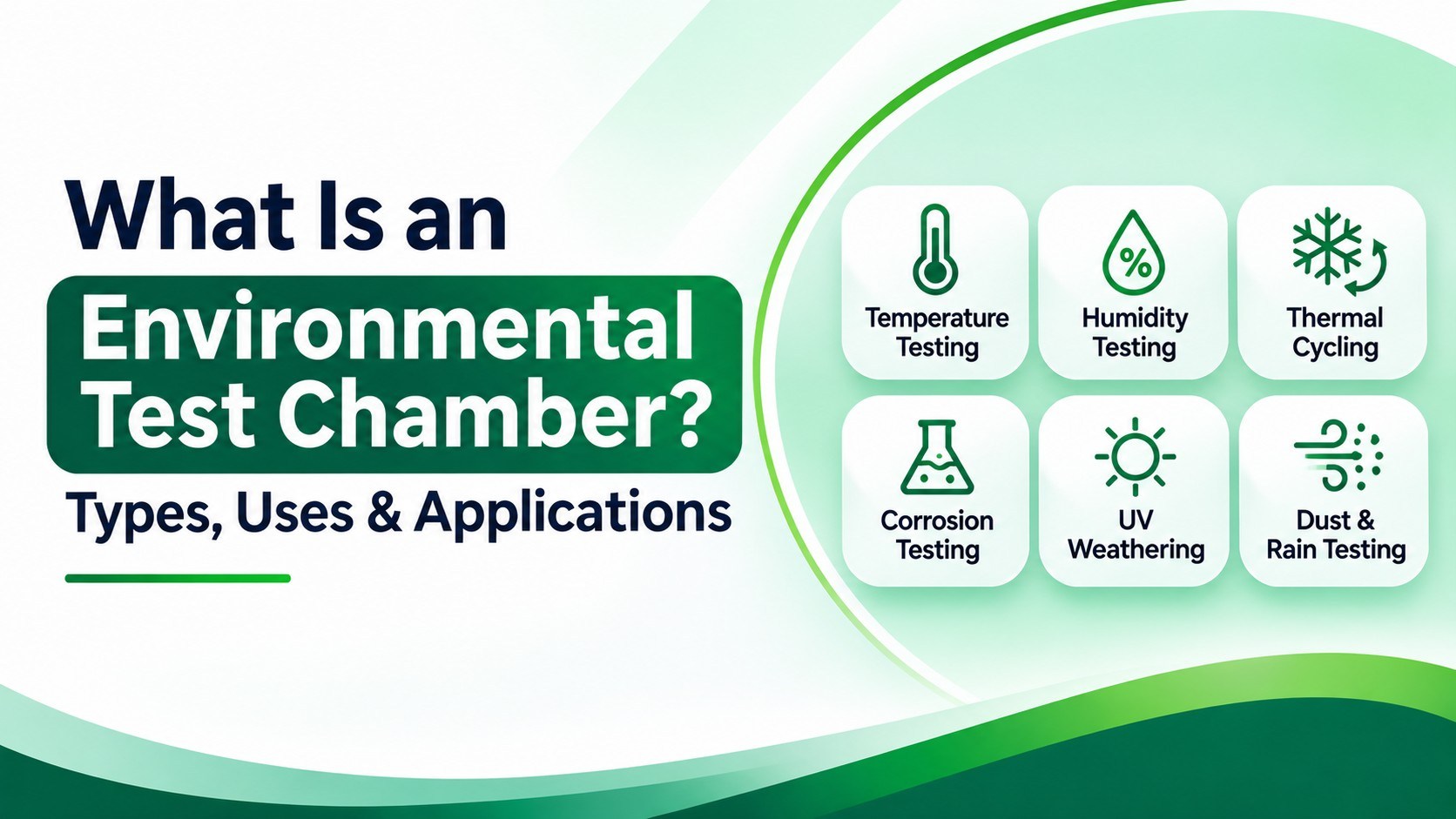
An environmental test chamber is specialized testing equipment used to simulate controlled environmental conditions such as extreme temperatures, humidity, thermal shock, and other climatic stresses. Manufacturers use these chambers to evaluate product performance, durability, and reliability before products reach the market.
Environmental test chambers are widely used in automotive, electronics, aerospace, defence, pharmaceutical, and industrial manufacturing applications. By reproducing challenging environmental conditions in a controlled setting, engineers can identify potential product failures, validate designs, and improve quality.
In this guide, we explain how environmental test chambers work, their different types, major applications, relevant testing standards, and the factors to consider when choosing a chamber.
What is an Environmental Test Chamber?
An environmental test chamber is an enclosed testing system designed to expose products, materials, or components to specific environmental conditions under controlled laboratory settings.
Depending on the chamber design, these conditions may include:
- High and low temperatures
- Controlled relative humidity
- Rapid temperature changes
- Corrosive salt-mist environments
- Dust and water exposure
- Simulated altitude conditions
- UV radiation and weathering
Not every environmental test chamber supports all these conditions. Different chamber types are engineered for specific testing requirements.
For example, an electronics manufacturer may use a temperature and humidity test chamber to evaluate circuit-board performance under hot and humid conditions. An automotive component manufacturer may use a thermal shock chamber to investigate how rapid temperature changes affect materials and assemblies.
The primary purpose of environmental testing is to identify potential weaknesses and verify product performance under defined environmental conditions.
How Does an Environmental Test Chamber Work?
An environmental test chamber operates by creating and maintaining controlled conditions inside an insulated testing enclosure.
The exact operating mechanism depends on the type of chamber and the environmental conditions being simulated.
1. Temperature Control
Heating and refrigeration systems regulate the chamber’s internal temperature.
A programmable controller manages the temperature according to predefined test parameters, allowing engineers to conduct high-temperature, low-temperature, or temperature-cycling tests.
2. Humidity Regulation
Temperature and humidity chambers use humidification and dehumidification systems to control relative humidity.
These systems help simulate humid environments and assess how moisture affects materials, electrical components, and finished products.
3. Air Circulation
Air circulation systems distribute conditioned air throughout the test space.
Proper airflow is important for maintaining consistent environmental conditions and reducing temperature differences within the chamber.
4. Monitoring and Automation
Modern environmental test chambers may include programmable logic controllers (PLCs), touchscreen human-machine interfaces (HMIs), sensors, alarms, and data-logging functions.
These features allow operators to configure test cycles, monitor chamber conditions, and maintain records for quality assurance.
5. Test Evaluation
Once the specified exposure cycle is complete, engineers inspect or measure the test specimen.
Evaluation may include visual inspection, electrical testing, dimensional measurements, functional checks, or other acceptance criteria defined by the applicable test procedure.
Types of Environmental Test Chambers
Environmental testing requirements vary across industries. Different chamber types are used to reproduce particular environmental stresses.
1. Temperature and Humidity Test Chambers
A temperature and humidity test chamber controls both temperature and relative humidity within a defined test space.
These chambers are commonly used to investigate the effects of heat, cold, and moisture on products.
Common applications:
- Electronic components and circuit boards
- Automotive electrical assemblies
- Industrial sensors and controllers
- Packaging and material evaluation
- Product reliability testing
Temperature and humidity testing helps engineers evaluate moisture sensitivity, material degradation, and performance under specified climatic conditions.
2. Thermal Shock Test Chambers
A thermal shock test chamber exposes specimens to rapid transitions between high and low temperatures.
Rapid thermal changes can create expansion and contraction stresses in materials and assemblies.
Common applications:
- Electronic assemblies
- Semiconductor components
- Automotive components
- Aerospace materials
- Metal and plastic assemblies
Thermal shock testing can help identify cracking, connection failures, delamination, and other problems associated with sudden temperature changes.
3. Salt Spray Test Chambers
A salt spray test chamber creates a controlled saline mist environment for corrosion testing.
These chambers are used to evaluate the corrosion resistance of coatings, metals, plated components, and surface treatments.
Common applications:
- Automotive metal components
- Industrial fasteners
- Painted and coated materials
- Electrical enclosures
- Metal finishing processes
Salt spray testing provides a standardized way to compare corrosion performance under defined conditions. Results should not automatically be treated as a direct prediction of real-world service life.
4. UV Accelerated Weathering Test Chambers
UV weathering chambers expose materials to controlled ultraviolet radiation, often combined with moisture and temperature cycles.
They help evaluate how materials respond to environmental ageing.
Common applications:
- Plastics and polymers
- Paints and coatings
- Exterior building materials
- Automotive exterior components
- Outdoor industrial products
These tests can reveal changes such as discoloration, cracking, loss of gloss, and surface deterioration.
5. Dust and Rain Test Chambers
Dust and rain test chambers are designed to evaluate product resistance to particulate matter and water exposure.
They are particularly useful for products that operate in outdoor, industrial, or dusty environments.
Common applications:
- Electrical enclosures
- Automotive lighting
- Industrial control panels
- Outdoor electronic equipment
- Electrical connectors
Testing may follow relevant ingress-protection procedures, including those specified in IEC 60529.
6. Walk-In Environmental Test Chambers
Walk-in environmental test chambers provide larger testing spaces for oversized products or multiple test specimens.
These systems are suitable when conventional benchtop or cabinet-style chambers cannot accommodate the required load.
Common applications:
- Large automotive assemblies
- Industrial equipment
- Aerospace components
- Bulk product testing
- Large electrical systems
Walk-in chambers may be customized according to test-space dimensions, temperature requirements, humidity conditions, and product-loading needs.
7. Altitude Test Chambers
Altitude test chambers simulate reduced atmospheric pressure to evaluate equipment performance under high-altitude conditions.
Some configurations combine pressure control with temperature simulation.
Common applications:
- Aerospace electronics
- Aviation equipment
- Electrical components
- Sealed assemblies
- Industrial equipment used at high elevations
These tests help evaluate the effects of reduced pressure on equipment operation and material performance.
Environmental Test Chamber Types: Quick Comparison
| Chamber Type | Main Testing Purpose | Typical Applications |
|---|---|---|
| Temperature & Humidity Chamber | Heat, cold, and moisture exposure | Electronics, automotive |
| Thermal Shock Chamber | Rapid temperature transitions | Semiconductors, assemblies |
| Salt Spray Chamber | Corrosion resistance | Metals, coatings |
| UV Weathering Chamber | Accelerated UV and weathering exposure | Plastics, paints |
| Dust Test Chamber | Dust ingress resistance | Electrical enclosures |
| Rain Test Chamber | Water ingress resistance | Outdoor equipment |
| Walk-In Chamber | Large-scale climatic testing | Industrial assemblies |
| Altitude Chamber | Reduced-pressure exposure | Aerospace equipment |
The appropriate chamber depends on the environmental stress being evaluated, the specimen’s dimensions, and the applicable testing requirements.
Applications of Environmental Test Chambers Across Industries
Automotive Industry
Automotive components are exposed to temperature fluctuations, humidity, dust, water, and other environmental conditions throughout their operating life.
Environmental chambers help manufacturers evaluate electronic control units, sensors, connectors, lighting assemblies, and other automotive components.
Testing can support product development, reliability assessment, and validation against relevant automotive specifications.
Electronics and Electrical Industry
Electronic devices may experience failures caused by thermal expansion, condensation, moisture exposure, or temperature-sensitive components.
Environmental testing helps engineers assess the performance of circuit boards, connectors, sensors, batteries, and electrical assemblies under specified operating or storage conditions.
Aerospace and Defence Industry
Aerospace and defence equipment may encounter extreme temperatures, reduced atmospheric pressure, humidity, and rapid environmental changes.
Environmental chambers help evaluate components against applicable product and programme requirements.
Depending on the application, testing may reference standards such as MIL-STD-810 or relevant IEC procedures.
Pharmaceutical Industry
Pharmaceutical stability testing uses controlled environmental conditions to evaluate the quality and stability of medicines and related products over time.
Specialized stability chambers maintain defined temperature and humidity conditions according to the applicable stability protocol.
These systems differ from general-purpose environmental chambers because pharmaceutical applications may require specific monitoring, qualification, documentation, and regulatory controls.
Industrial Manufacturing
Industrial manufacturers use environmental testing to evaluate materials, coatings, electrical equipment, and mechanical assemblies.
Testing can help identify weaknesses before large-scale production and support product design improvements.
Environmental Testing Standards You Should Know
Environmental testing is often conducted according to recognized standards or customer-defined specifications.
Some commonly referenced standards include:
| Standard | Relevant Testing Area |
|---|---|
| IEC 60068-2-1 | Cold testing |
| IEC 60068-2-2 | Dry heat testing |
| IEC 60068-2-14 | Change of temperature |
| IEC 60068-2-30 | Cyclic damp heat |
| IEC 60068-2-78 | Steady-state damp heat |
| IEC 60068-2-11 | Salt mist testing |
| IEC 60529 | Degrees of protection against ingress |
| MIL-STD-810 | Environmental engineering considerations and laboratory tests |
The applicable standard depends on the product, industry, testing objective, and customer requirements.
Important: A chamber’s ability to achieve certain environmental conditions does not automatically establish that a complete test complies with a particular standard. Test procedures, specimen preparation, instrumentation, exposure duration, and acceptance criteria must also be considered.
How to Choose the Right Environmental Test Chamber
Selecting an environmental test chamber requires more than comparing equipment prices.
The chamber must meet the technical requirements of the intended testing programme.
1. Identify Your Testing Requirements
Start by determining which environmental conditions need to be simulated.
For example, temperature cycling, humidity exposure, corrosion testing, and thermal shock require different equipment capabilities.
2. Check Temperature and Humidity Ranges
Confirm that the chamber supports the required temperature and humidity conditions.
Consider operating limits, control accuracy, uniformity, and stability under the expected specimen load.
3. Determine Chamber Size and Capacity
The chamber must accommodate the test specimen while maintaining adequate airflow and clearance.
Large assemblies or bulk testing requirements may require a walk-in chamber.
4. Evaluate Controller and Monitoring Features
Programmable controllers, data logging, alarms, and monitoring systems can improve operational convenience and test traceability.
Confirm that the available features match your testing and documentation requirements.
5. Review Calibration and Maintenance Requirements
Reliable environmental testing depends on appropriate calibration, performance verification, and routine maintenance. Ask the manufacturer about calibration support, preventive maintenance, spare parts, and technical service.
6. Consider Customization Options
Standard chambers may not meet every application.
Custom requirements can include specimen fixtures, access ports, viewing windows, additional sensors, special chamber dimensions, or tailored control systems.
Environmental Test Chambers by Provert Systems
Provert Systems & Solutions is an Indian manufacturer of environmental simulation testing equipment, supporting industrial manufacturers, research laboratories, and quality-control teams.
Its product portfolio includes:
- Environmental Test Chambers
- Temperature and Humidity Chambers
- Thermal Shock Chambers
- Salt Spray Test Chambers
- UV Accelerated Weathering Chambers
- Dust and Rain Test Chambers
- Altitude Test Chambers
- Walk-In Test Chambers
Provert Systems offers standard and customized chamber configurations to address different industrial testing requirements.
Customers can discuss their required test conditions, chamber dimensions, control features, and application-specific needs with the technical team.
Looking for an environmental test chamber in India?
Explore the environmental testing equipment offered by Provert Systems or contact the team to discuss your testing requirements and request a quotation.
Conclusion
Environmental test chambers play an important role in modern product development, quality assurance, and reliability testing. By simulating controlled environmental stresses, these systems help engineers identify potential weaknesses, evaluate product performance, and validate designs before deployment. Choosing the right chamber requires careful consideration of testing standards, operating conditions, specimen dimensions, chamber performance, and long-term technical support. Provert Systems & Solutions provides environmental testing equipment for a range of industrial applications, including standard and customized solutions.
Explore Provert Systems’ environmental test chambers to find equipment suited to your testing requirements.