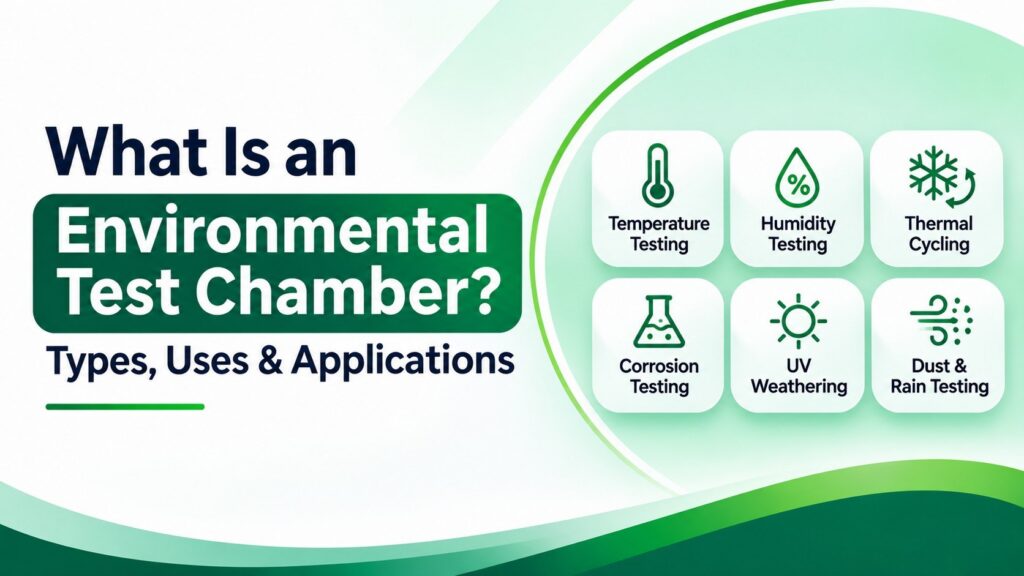

A temperature and humidity test chamber is a specialized environmental testing system used to simulate controlled temperature and moisture conditions. It allows manufacturers, research laboratories, and quality-control teams to evaluate how products, materials, and components respond to different climatic environments.
Products may encounter high temperatures, low temperatures, humidity, and changing weather conditions during storage, transportation, and operation. These environmental factors can affect material properties, electrical performance, dimensional stability, and overall product reliability.
Temperature and humidity testing helps engineers identify potential weaknesses, evaluate product behaviour, and verify performance under specified conditions.
This guide explains the working principle of temperature and humidity test chambers, their main components, common applications, benefits, testing standards, and important factors to consider when selecting equipment.
What is a Temperature and Humidity Test Chamber?
A temperature and humidity test chamber is an enclosed testing system designed to maintain controlled temperature and relative humidity conditions for environmental testing.
It typically combines heating, refrigeration, humidification, dehumidification, air circulation, and electronic control systems.
Depending on its design, the chamber may perform constant-temperature testing, steady-state humidity testing, cyclic damp heat testing, and programmed temperature-humidity exposure.
The primary purpose of a temperature and humidity test chamber is to evaluate product performance and reliability under controlled climatic conditions.
These chambers are commonly used for testing electronic components, automotive assemblies, industrial equipment, packaging materials, and other products sensitive to temperature and moisture.
How does a Temperature and Humidity Test Chamber Work?
A temperature and humidity test chamber works by continuously monitoring the conditions inside an insulated enclosure and adjusting its heating, cooling, humidification, and dehumidification systems to maintain the required test environment.
The operating process typically involves five stages.
1. Temperature Generation and Control
Temperature control is achieved using heating and cooling systems.
Electrical heaters increase the chamber temperature, while refrigeration systems remove heat to achieve lower temperatures.
A programmable controller compares the measured temperature with the required setpoint and adjusts the heating or cooling output accordingly.
For example, a test may require a component to remain at 60°C for a specified period before the temperature is reduced to another setpoint.
The chamber follows the programmed temperature profile within its operating capabilities.
2. Humidity Generation
Humidity control involves increasing or decreasing the moisture content of the chamber air.
Humidification systems introduce water vapour into the test space using methods such as steam generation or other controlled humidification technologies.
Humidity sensors continuously measure relative humidity, allowing the controller to adjust the humidification process.
For example, a test procedure may require the chamber to maintain 85% relative humidity at a specified temperature.
The ability to maintain this condition depends on the chamber’s humidity operating range and design.
3. Dehumidification
Dehumidification reduces moisture levels inside the chamber.
Depending on the equipment design, moisture may be removed through cooling and condensation or other dehumidification methods.
This process is important when the test requires lower humidity conditions or controlled transitions between humidity setpoints.
Not every temperature and humidity combination is achievable, so users should check the manufacturer’s specified humidity operating envelope.
4. Air Circulation and Uniformity
Air circulation systems distribute conditioned air throughout the chamber.
Fans move air across the heating, cooling, and humidity-control components to help maintain consistent environmental conditions.
Proper circulation reduces differences in temperature and humidity across the usable test space.
However, specimen size, positioning, heat generation, and airflow obstruction can affect uniformity.
5. Monitoring and Feedback Control
Temperature and humidity sensors continuously provide measurements to the chamber controller.
The controller compares these measurements with the programmed setpoints and adjusts the relevant systems.
This feedback-control process helps maintain the required conditions throughout the testing cycle.
Many chambers also support programmable test profiles, alarms, data logging, and monitoring functions.
Main Components of a Temperature and Humidity Test Chamber
A temperature and humidity chamber contains several interconnected systems.
| Component | Function |
|---|---|
| Insulated Test Enclosure | Provides a controlled testing space |
| Heating System | Raises chamber temperature |
| Refrigeration System | Removes heat for cooling |
| Humidification System | Increases moisture content |
| Dehumidification System | Reduces moisture content |
| Air Circulation Fans | Distribute conditioned air |
| Temperature Sensors | Measure internal temperature |
| Humidity Sensors | Measure relative humidity |
| Programmable Controller | Regulates test conditions |
| Data Logging System | Records test parameters where provided |
The configuration and capabilities of these components vary according to chamber design, operating range, capacity, and intended application.
Types of Temperature and Humidity Testing
Temperature and humidity chambers support different environmental testing procedures.
1. Constant Temperature Testing
Constant-temperature testing exposes a specimen to a specified temperature for a defined period.
It helps engineers evaluate product behaviour during sustained high- or low-temperature exposure.
Applications may include material evaluation, electronic component testing, and product performance verification.
2. Steady-State Humidity Testing
Steady-state humidity testing exposes specimens to controlled temperature and humidity conditions over a specified duration.
It is commonly used to investigate moisture-related effects on materials, electrical insulation, and assembled products.
For example, an electronic assembly may undergo prolonged damp heat exposure to assess changes in electrical or physical performance.
3. Cyclic Temperature and Humidity Testing
Cyclic testing involves programmed changes in temperature and humidity.
These cycles can help investigate how repeated climatic variations affect materials and components.
Depending on the test procedure, cyclic conditions may promote moisture absorption, condensation, or thermal stress.
4. Temperature Cycling Testing
Temperature cycling exposes products to repeated high- and low-temperature conditions.
This testing helps evaluate the effects of thermal expansion and contraction on materials and assemblies.
Unlike thermal shock testing, conventional temperature cycling typically follows a controlled temperature-change profile rather than requiring very rapid transitions.
Applications of Temperature and Humidity Test Chambers
Temperature and humidity testing is used across industries where product performance may be affected by environmental conditions.
Automotive Industry
Automotive components are exposed to varying temperatures and humidity throughout their operating life.
Temperature and humidity chambers help evaluate the environmental resistance of electronic control units, sensors, connectors, lighting assemblies, and other automotive components.
For example, a vehicle’s electronic control module may be subjected to specified damp heat conditions to investigate moisture sensitivity and electrical performance.
Testing can support component validation, product development, and quality assurance.
Electronics and Electrical Industry
Electronic assemblies may experience performance changes or failures due to moisture exposure, temperature fluctuations, and thermal expansion.
Temperature and humidity testing helps evaluate:
- Printed circuit boards
- Electrical connectors
- Sensors and controllers
- Power electronics
- Insulation materials
- Electronic assemblies
Testing may reveal changes in insulation resistance, corrosion behaviour, material stability, or electrical functionality.
Pharmaceutical Industry
Pharmaceutical stability testing requires carefully controlled environmental conditions.
Specialized stability chambers maintain defined temperature and humidity conditions for stability studies.
Such studies may follow applicable ICH guidelines and regulatory requirements.
Pharmaceutical applications can require additional controls, qualification, calibration, monitoring, alarms, and documentation beyond those of general-purpose environmental test chambers.
Aerospace and Defence Industry
Aerospace and defence equipment may experience temperature extremes and humidity exposure during storage, transportation, or operation.
Temperature and humidity testing helps engineers assess the environmental performance of electronic equipment, materials, and assemblies.
Testing procedures depend on the relevant product specifications and environmental qualification requirements.
Packaging and Material Testing
Temperature and humidity changes can affect packaging materials, adhesives, plastics, paper products, and other materials.
Testing helps evaluate properties such as:
- Moisture absorption
- Dimensional stability
- Adhesive performance
- Material deformation
- Surface deterioration
- Packaging integrity
These evaluations can support material selection and packaging development.
Industrial Manufacturing
Industrial manufacturers use temperature and humidity chambers to evaluate sensors, electrical systems, mechanical components, and other products.
Controlled testing helps identify potential environmental weaknesses and assess whether equipment meets specified operating or storage requirements.
Benefits of Temperature and Humidity Test Chambers
1. Early Identification of Product Weaknesses
Controlled environmental exposure can reveal potential problems before products are released.
Examples include moisture-related corrosion, insulation deterioration, material deformation, and changes in electrical performance.
Identifying these weaknesses during development can support design improvements.
2. Improved Product Reliability Assessment
Temperature and humidity testing provides evidence of how products behave under defined environmental conditions.
Combined with functional testing and appropriate acceptance criteria, these results help engineers assess product reliability.
3. Repeatable Testing Conditions
Environmental chambers allow laboratories to reproduce specified climatic conditions.
Repeatability is important when comparing product designs, material changes, manufacturing batches, and test results.
4. Support for Quality Assurance
Temperature and humidity testing can form part of product validation, quality-control procedures, and supplier qualification programmes.
It helps manufacturers evaluate whether products meet defined environmental performance requirements.
5. Support for Industry Testing Standards
Environmental chambers provide controlled conditions for relevant standardized tests.
However, meeting a temperature or humidity setpoint alone does not establish complete compliance with a test standard.
The full procedure, including specimen preparation, exposure duration, measurements, and acceptance criteria, must also be followed.
6. Reduced Risk of Environmental Failures
By identifying vulnerabilities during testing, manufacturers can make design or material changes before products enter service.
This can help reduce the risk of environment-related failures, although test results cannot guarantee that a product will never fail in real-world conditions.
Temperature and Humidity Testing Standards
Several internationally recognized standards define environmental testing procedures.
| Standard | Testing Application |
|---|---|
| IEC 60068-2-1 | Cold testing |
| IEC 60068-2-2 | Dry heat testing |
| IEC 60068-2-30 | Cyclic damp heat testing |
| IEC 60068-2-78 | Steady-state damp heat testing |
| IEC 60068-2-14 | Change of temperature |
| MIL-STD-810 | Environmental engineering and laboratory test methods |
| ICH Q1A(R2) | Stability testing of new drug substances and products |
The appropriate standard depends on the product, industry, intended operating conditions, and test objective.
For pharmaceutical stability applications, the applicable regulatory requirements and product-specific stability protocols must also be considered.
How to Choose the Right Temperature and Humidity Test Chamber
Selecting a suitable chamber requires evaluating its technical capabilities against the intended testing requirements.
1. Temperature Operating Range
Determine the minimum and maximum temperatures required by the test procedure.
Confirm that the chamber can maintain these conditions with the expected specimen load.
2. Humidity Operating Range
Review the chamber’s supported relative humidity range at the required temperatures.
Humidity control capability is not necessarily the same across the entire temperature operating range.
3. Chamber Capacity
Select a chamber with sufficient internal space for the test specimens.
Proper clearance is important for airflow and consistent environmental exposure.
4. Temperature Stability and Uniformity
Temperature stability describes how much the temperature varies over time at a specified measurement point under defined conditions.
Temperature uniformity describes differences between measurement locations within the test space.
Both parameters can affect test accuracy and repeatability.
5. Temperature Ramp Rate
The required heating and cooling rates should be considered when selecting a chamber for cyclic testing.
Actual ramp-rate performance can vary depending on specimen mass, heat generation, and chamber loading.
6. Monitoring and Data Logging
Depending on the application, useful features may include programmable profiles, alarm systems, data logging, remote monitoring, and test-result export.
These functions can support test documentation and traceability.
7. Calibration and Maintenance
Regular calibration and maintenance help maintain confidence in chamber performance.
Review the manufacturer’s recommendations, calibration requirements, service availability, and maintenance procedures.
Common Mistakes to Avoid During Temperature and Humidity Testing
Even when suitable equipment is available, incorrect test setup can affect the reliability of results.
Overloading the chamber: Excessive specimen loading can obstruct airflow and influence environmental uniformity.
Ignoring humidity operating limits: A chamber may not be able to maintain every humidity setpoint at every temperature.
Incorrect sensor placement: Improper monitoring locations can produce measurements that do not adequately represent specimen exposure.
Insufficient stabilization time: Test specimens may require additional time to reach the intended conditions after the chamber reaches its setpoint.
Confusing chamber temperature with specimen temperature: The specimen may heat or cool more slowly than the surrounding air.
Inadequate calibration: Poorly maintained sensors and control systems can affect measurement confidence.
Following the relevant test procedure and equipment instructions helps minimize these issues.
Conclusion
Temperature and humidity test chambers play an important role in evaluating how products, materials, and components respond to controlled climatic conditions.
By combining temperature regulation, humidity control, air circulation, and programmable monitoring systems, these chambers support repeatable environmental testing across multiple industries.
Understanding their working principles, testing capabilities, and operating limitations helps engineers select appropriate equipment and develop reliable test procedures.
When choosing a temperature and humidity test chamber, factors such as operating range, chamber capacity, uniformity, stability, monitoring features, and calibration requirements should be carefully evaluated.
For application-specific requirements, manufacturers can consult environmental testing equipment specialists, including Provert Systems, to assess suitable chamber configurations.